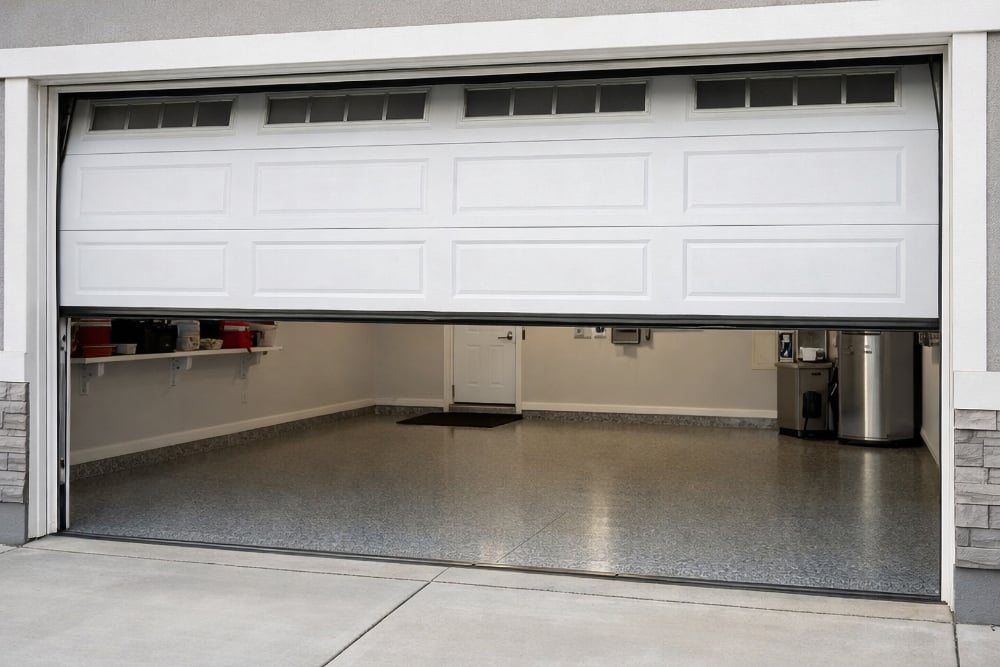
Your garage door got halfway up (or halfway down) and stopped. Now it won’t budge either direction. Frustrating, especially if your car’s trapped inside or the house is sitting open.
Here’s what could be going on, what you can check yourself, and when you need to call someone.
Why Does a Garage Door Stop Halfway?
There are a handful of common causes. Some you can sort out in five minutes. Others need a qualified technician.
The motor’s limit settings are off
Every automatic garage door opener has limit switches – they tell the motor where “fully open” and “fully closed” are. If these get knocked out of adjustment (power surge, age, or someone’s been fiddling with the opener), the motor hits what it thinks is the end point and stops. Mid-door.
This is one of the easier fixes. The limit adjustment screws are usually on the side of the motor unit – your opener manual will show you where. That said, if you’re not confident adjusting electronics, leave it to a tech.
A spring has broken
This is the most common cause of a door stopping mid-travel – and it’s the one you should not try to fix yourself.
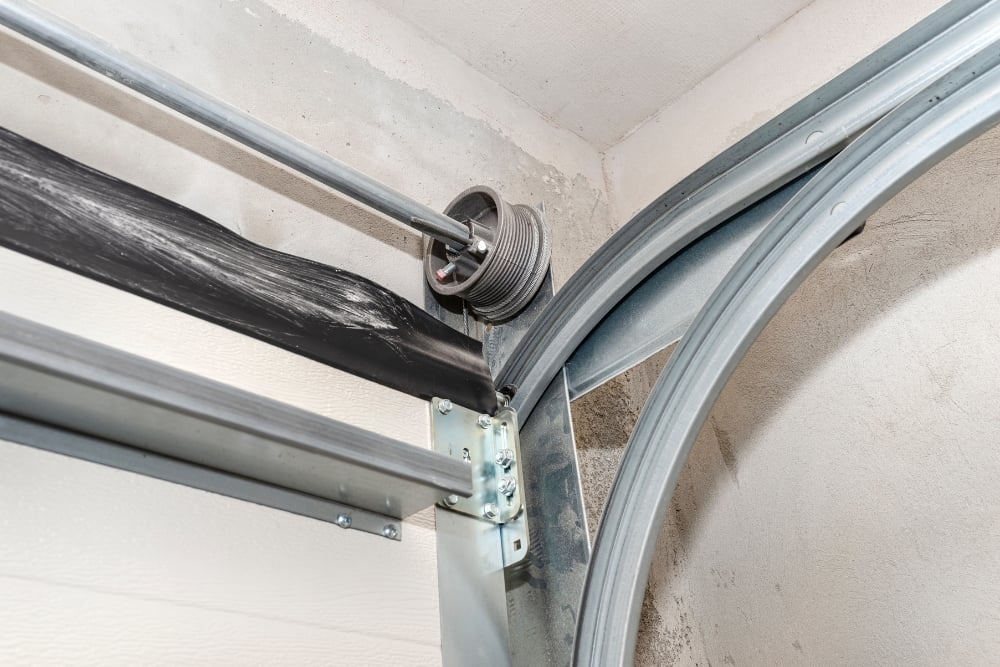
Your garage door runs on torsion springs (the horizontal spring above the door) or extension springs (the springs that run along the sides). These are under enormous tension. A broken spring means the door’s counterbalance system has failed. The opener tries to lift a door that now weighs its full 50-80kg without any assistance, hits the motor’s safety load limit, and shuts down.
You’ll often hear a loud bang when a spring breaks it sounds like something fell off a shelf in the garage. If you heard that recently and your door’s now stuck, that’s almost certainly the cause.
The track has an obstruction or is out of alignment
The rollers that carry your door up the track can hit a dent, a gap in the track, or a piece of debris and jam. The safety mechanism kicks in and the doorstops.
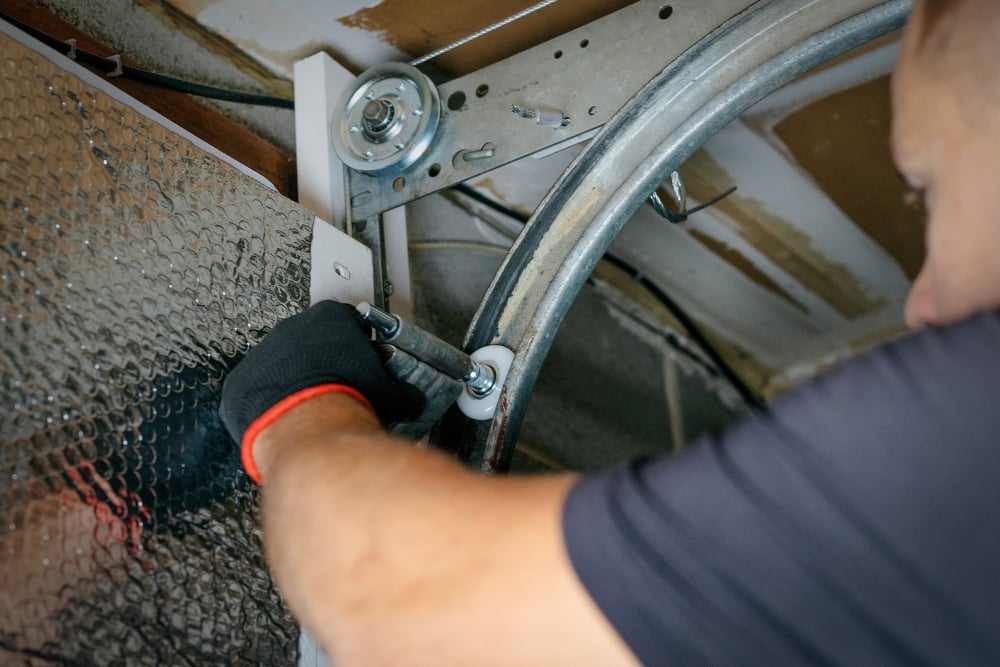
Run your eyes along both tracks (the vertical sections especially). Look for obvious dents, gaps, or anything jammed in the roller path. Small debris you can clear yourself. Bent or misaligned tracks will need straightening by a tech – forcing the door past a track problem will make it worse and can damage the rollers.
The safety sensors are blocked or misaligned
Most automatic doors have photo-eye sensors near the bottom of the tracks on both sides. They shoot an infrared beam across the door opening. If anything breaks that beam – a leaf, a cobweb, a toy, a bin that’s shifted – the door thinks something is in the way and stops or reverses.
Check the sensor lights. Both units should show a solid light (usually green on the receiver, and amber on the sender). If one is flashing or off, the beam is interrupted or the sensors have knocked out of alignment. Clean the lenses with a dry cloth and check they’re pointing directly at each other.
The cable has slipped or snapped
The steel cables attach to the bottom of the door and wind around drums at the top when the door opens. A frayed or snapped cable means one side of the door loses tension and the door can jam, tilt, or stop mid-travel.
If you can see a cable hanging loose inside the garage, don’t force the door. This one needs a technician.
The opener’s trolley has disengaged
Most openers have a red emergency release cord that disconnects the door from the motor drive – it lets you operate the door manually during a power outage. If someone’s pulled that cord (kids are often responsible here), the opener runs but the door doesn’t move with it. You’ll hear the motor going but nothing happens.
Re-engage the trolley by pulling the release cord toward the motor (away from the door) until you hear a click. Or manually move the door to the fully closed position and then activate the opener – on most systems it will re-engage automatically.
What You Can Check Yourself
Before calling anyone, run through this:
- Check the sensors – Look for solid lights on both sensor units. Clear any debris from in front of them.
- Look at the tracks – Any obvious dents, debris, or gaps in the roller path?
- Check the emergency release – Has the red cord been pulled? If so, re-engage as above.
- Did you hear anything when it happened – Did you hear a bang recently? That points to a broken spring.
- Try the manual operation – Pull the emergency release and try lifting the door by hand. If it’s extremely heavy (doesn’t lift easily with two hands), a spring has likely broken.
What to Leave Alone
- Don’t attempt to manually force the door past a jam. You can bend tracks, crack panels, or put real strain on the opener motor.
- Don’t attempt spring replacement yourself. This is the one we’ll be direct about – torsion springs under load can cause serious injury if released without the right tools and training. It’s not a DIY job, regardless of what you find on YouTube.
- Don’t keep running the opener if the door’s stuck. Repeatedly triggering the motor against a jam can burn out the motor.
When to Call a Technician
Call us if:
- You heard a bang and the door won’t lift – broken spring
- A cable is visibly loose or hanging off the drum
- The track is bent or a section has come away from the wall
- You’ve checked the sensors and they look fine, but the door still stops in the same spot every time
- The door opens or closes slightly then reverses for no obvious reason
Most of these are same-day or next-morning jobs. A broken spring typically takes 45-90 minutes to replace. Track repairs depend on what we find.
A Note on Older Doors
If your door’s more than 10-15 years old and you’re having repeated issues – stops mid-travel, cables fraying, springs breaking again after replacement – it’s worth having a full service done at the same time. Springs have a cycle life (usually 10,000 cycles for standard springs), and when one goes, the other is often not far behind. Replacing both at the same time saves a second call-out.
Coast to Valley Garage Doors – Newcastle, Lake Mac, Hunter Valley
We cover Newcastle, Lake Macquarie, Cessnock and the Hunter Valley. Repairs, spring replacements, cable replacements, motor servicing and new installations.
Call us for same-day service on broken springs and urgent repairs on (02) 9161 6170